
The first part of this trip has taken us to a few of the places that my ancestors lived. I mentioned in an earlier post that two of my great-grandparents were born in Norfolk, one on each side of my family. Both were born at a time when rural labourers worked on large farms that had been created after common grazing land was enclosed and given over to private ownership.
The last time we visited Norfolk, we found where my great-grandmother was born. Some of you have admired the photograph I took of the fields around her birthplace (the village being long gone), which used to hang in our house in Pender.

This time we searched in vain for the village where my great-grandfather was born. We found the sign and a headstone for a family member, but everything else seemed to have disappeared.
We had better luck with the present-day relatives.
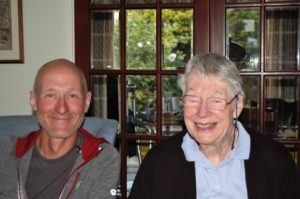
We began with Julian’s Aunt Jennifer, who is his mother’s sister. She lives in the pretty village of Ingatestone in Essex. Fifty years ago Essex was a rural county, but it’s now a commuting suburb because it’s within an hour’s drive of London.
Here are Julian and Jennifer:
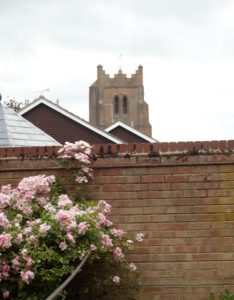
Jennifer’s pretty garden has a view of the 11th century church on the High Street.
It can be awkward to stay with people you don’t know very well, but to whom you’re related. I’ve learned that the family history I’m compiling is a great conversation-starter. I’ve learned of open secrets in my family, and I’ve scored some fantastic family photos from both my relatives and Julian’s. Jennifer was able to provide me with a photograph of Julian’s great-great-grandfather taken in about 1870 with his son, Julian’s great-grandfather. Sorry I can’t include it in this blog because I didn’t bring my portable scanner with me! I’ll include it in the family history, which I hope to circulate once we return to Canada.
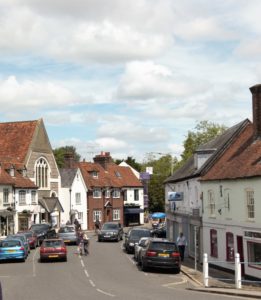
Next we travelled to the village of Hungerford in Berkshire. This was where my mother’s grandmother was born.
Hungerford is a market town located about 100 km west of London. The village likely was the inspiration for Thomas Hardy’s novel Jude the Obscure. It’s been a village for almost a thousand years; the layout of its streets today is essentially the same as it was in the 1200s. We had lunch in a pub that was 400-500 years old; the Australian barkeeper wasn’t exactly sure. Hungerford became an important coach stop on the Bath to London road beginning in the 1600s. However, the introduction of rail transportation in the mid-1800s devastated coach travel. Today its streets appear to be frozen in the 18th century. Except for the traffic, of course.
Our next stop was Great Bedwyn, the even tinier village where my mother’s great-grandparents and her father were born. Great Bedwyn is just a few km down the road from Hungerford.
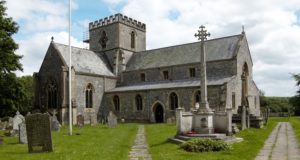
This is Church Street where the family lived when my grandfather was born, and the 11th century church for which the street is named. I know, we’re starting to get blase about 11th century churches too.
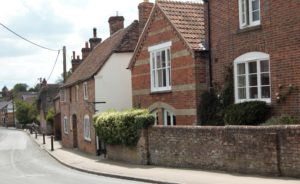
Momentarily back to the present.
We stayed with my mother’s cousin Everett and his wife Val for three days during which time we had lunch with my mother’s other cousin and Everett’s sister, Pam, her husband Dick, their son Nick and his wife Janet. Everyone was lovely to us. It was so nice to be part of an extended family after years of thinking that family meant just our parents and my brother!
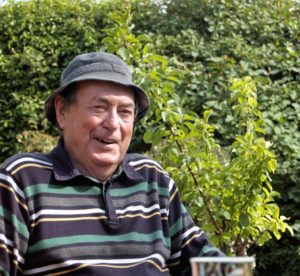
Everett
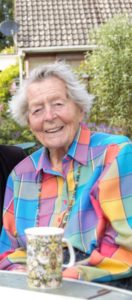
Pam
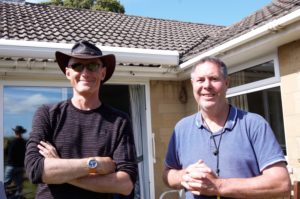
Julian & Nick
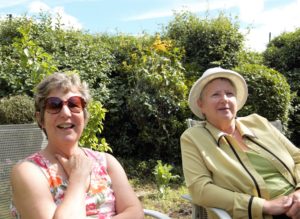
Janet & Val
Val and Everett prepared me for the final leg of the Rellie Trip by watching Far from the Madding Crowd with me – the original ’60s version with Julie Christie and Alan Bates, not the inferior version made the hunky Belgian actor a few years ago.
Our last stop was the rural parish of West Tisbury in Wiltshire near the border with Dorset. It’s about 160 km and 200 years west of London. This is Thomas Hardy country. And also the area where my father’s great-grandfather was born before moving to London in the mid-1800s.
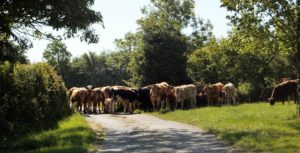
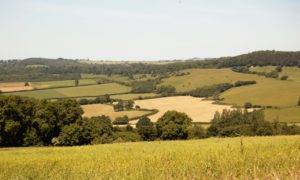
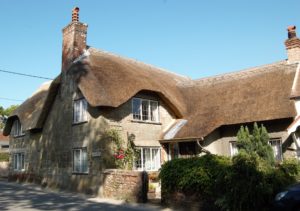
The manor house, Pythouse, and the farm where his parents worked, Hatch House, are still here.
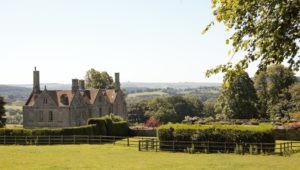
Hatch Farmhouse, West Tisbury
My great-great grandfather started a cab company in London – in the days when cabs were drawn by horses – before retiring back to West Tisbury and this little dot of a village, which is now little more than a country lane.
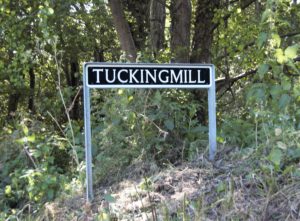
Finally, my lifelong love of Thomas Hardy explained.


